Product Description
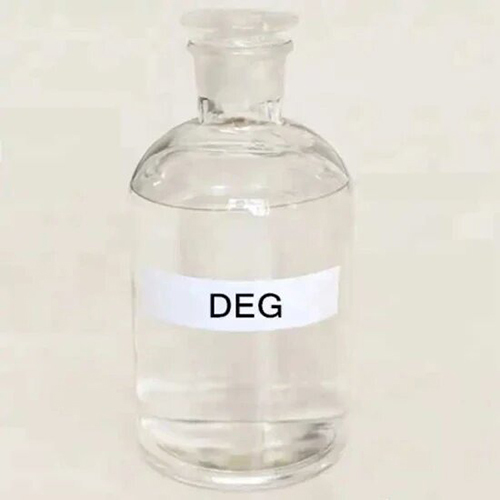
DEG is an important industrial solvent used as a plasticizer, antifreeze, and chemical intermediate. It improves flexibility and durability in plastics and is widely used in paints, dyes, inks, and resin production.
Applications/End-use Industries:
- Plasticizers in polymers (PVC)
- Antifreeze and coolant formulations
- Polyester resin manufacturing
- Paints, dyes, and ink production
- Adhesives and sealants
- Textile and paper industries
Versatile Applications in IndustryDiethylene Glycol's unique properties-such as its ability to dissolve in water and organic solvents, as well as its ideal viscosity-make it a preferred choice in industries ranging from manufacturing solvents and antifreeze to producing polyester resins. Its neutral pH and high purity ensure consistent and effective performance in these applications.
Safe Storage and HandlingFor prolonged stability and safety, DEG should be stored in a cool, dry, and well-ventilated area with containers kept tightly closed. With a shelf life of up to two years under recommended conditions, this compound remains stable and reliable, provided exposure to extreme conditions is avoided.
Chemical Characteristics at a GlanceDEG features a molecular formula C4H10O3 and a high boiling point of 245C. It has a density of 1.118 g/cm3 and is classified as an organic chemical. While odorless and sweet-tasting, it must be handled with care due to its toxicity if ingested. Its compatibility with various industrial requirements attests to its utility.
FAQ's of Di Ethylene Glycol (DEG):
Q: How should Diethylene Glycol be stored to ensure maximum shelf life?
A: Diethylene Glycol should be stored tightly closed in containers, in a cool, dry, and well-ventilated area. Proper storage helps maintain its stability and extends its shelf life up to two years.
Q: What are the primary industrial applications of Diethylene Glycol?
A: DEG is primarily used as a solvent, in antifreeze formulations, and in the manufacturing of polyester resins due to its excellent solubility and stability properties.
Q: When should precautions be taken while handling Diethylene Glycol?
A: Precautions should be taken at all times during handling, as DEG is toxic if ingested. Use appropriate personal protective equipment and adhere to safety guidelines to minimize risks.
Q: Where is Diethylene Glycol commonly used?
A: Diethylene Glycol is widely used in industrial settings such as chemical manufacturing plants, antifreeze production facilities, and polyester resin manufacturing units.
Q: What are the benefits of using Diethylene Glycol in industrial processes?
A: DEG offers excellent solvent properties, compatibility with many organic solvents, a neutral pH, and high stability, making it highly effective and versatile for various industrial processes.
Q: How is Diethylene Glycol typically packaged and transported?
A: It is commonly packaged in drums or Intermediate Bulk Containers (IBCs), facilitating safe storage and transportation for large-scale industrial use.
Q: What process should be followed if a DEG spill occurs?
A: If a spill occurs, ventilate the area, contain and absorb the liquid with inert material, and dispose of it according to local regulations. Always use personal protective equipment when cleaning up spills.

 Mon-Sat 10.00 AM - 7.00 PM



 Send Inquiry


 Send Inquiry
 Send SMS


